If your aluminum panel design uses the same round, square or slotted opening thousands of times, punching is usually the first process to quote. If the design uses free-form curves, lettering or a picture that changes across panels, laser cutting is usually the stronger candidate. That is a starting point, not a purchasing rule.
The right choice depends on the complete panel: pattern, sheet thickness, number of repeated panels, edge requirements, folds, finish and acceptable flatness. Send the same drawing and acceptance standard to each supplier. A cheap cutting price is not useful if deburring, straightening or pattern correction appears later as an extra.
First, clear up one common misunderstanding
“Perforated” describes a sheet or panel with openings. It does not prove how those openings were made. A perforated aluminum facade may use turret-punched holes, laser-cut openings or a combination of processes.
The useful question is not “Do I need a perforated panel or a laser-cut panel?” It is:
Which process can make this approved pattern, in this panel mix, with the required edge and flatness, at the lowest complete cost?
That wording gives the fabricator room to propose the right route. It also prevents a decorative product name from becoming an unnecessary manufacturing restriction.
Laser cutting vs punching: the practical comparison
| Decision point | Punching | Laser cutting |
|---|---|---|
| Repeated simple holes | Strong starting choice because one tool can make the same shape in rapid repeated strokes | Possible, but every opening still adds piercing and cutting time |
| Free-form curves or detailed artwork | May require nibbling or special tooling; edge marks and tool limits need review | Strong starting choice because the cutting path is controlled from the drawing rather than by a dedicated hole tool |
| Pattern changes from panel to panel | Tool shapes still limit the openings, although their positions can change | Well suited to variable panel artwork, subject to cut width, heat and part stability |
| Louvers, embossing or other formed features | Punch tooling can cut and form certain features in the same process | A laser cuts the outline but does not create a formed louver or emboss by itself |
| Edge appearance | A punched edge has a cut and fracture zone and may have a burr; nibbling can leave visible step marks | Edge quality depends on alloy, thickness, settings and assist gas; aluminum can still have dross or burr |
| Distortion risk | Repeated punching introduces mechanical stress, especially in dense patterns | Heat input and a dense cutting path can move or distort a thin sheet |
| Cost driver | Tool availability, setup, hit count, panel repetition and secondary work | Programming, piercing count, total cut length, machine time and secondary work |
TRUMPF’s punching and nibbling guide describes punching as a shear-cutting process and identifies repeated shapes as its strength. It also explains that complex contours can be handled by the unrestricted laser head on a punch-laser machine. This is why a capable fabricator may use both methods within one project rather than treat them as rivals.
Let the pattern choose the first quotation route
Use punching as the first quote when repetition is high
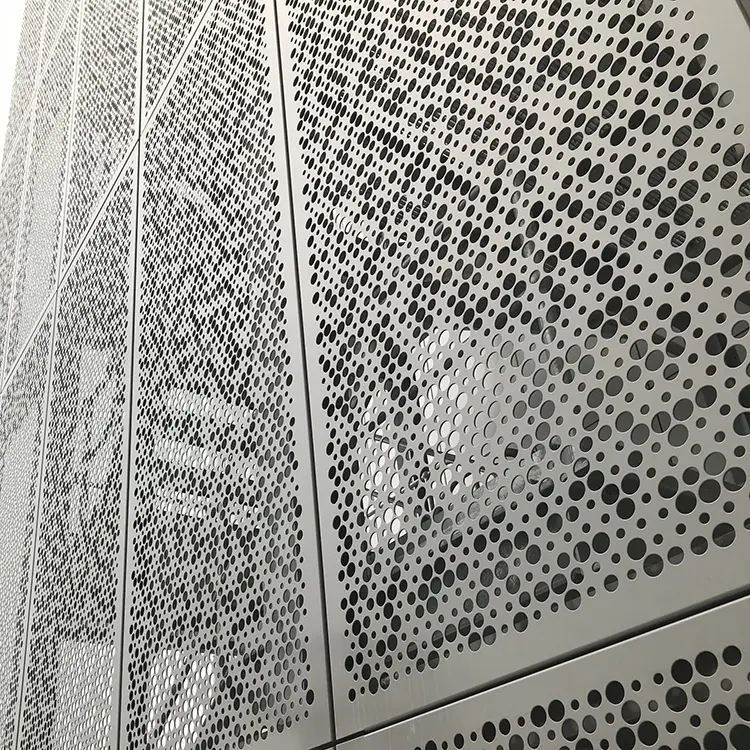
Uniform round holes, slots and other standard shapes are natural punching candidates. The advantage grows when the same opening and panel layout repeat many times. Cluster tools can make multiple openings per stroke, but the exact benefit depends on available tooling and the machine being used.
Do not send only a reference photo. Define:
- hole shape and nominal size;
- horizontal and vertical pitch, or the staggered layout;
- pattern start point and panel orientation;
- unperforated border around folds, joints and fixings;
- whether the front and back faces have different edge requirements;
- the quantity of each unique panel, not only the total area.
The last item matters. Five hundred identical panels and five hundred individually patterned panels are not the same punching job, even if their total square metres match.
Use laser cutting as the first quote for free-form artwork
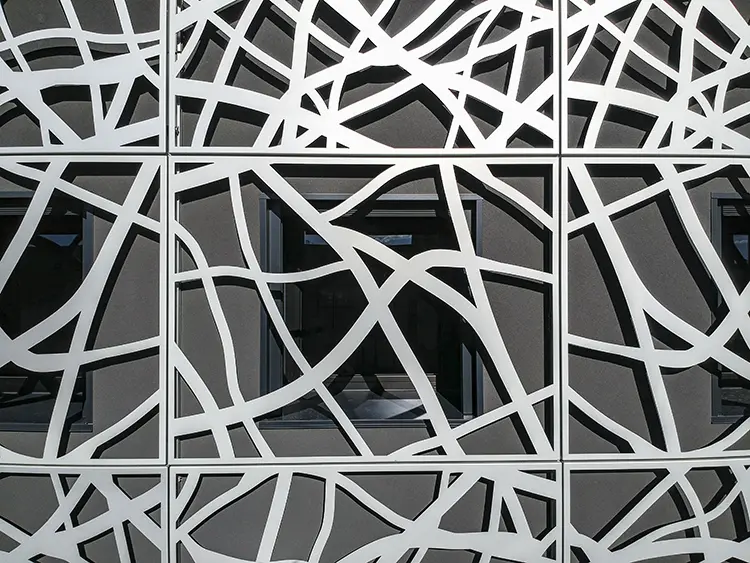
Laser cutting is a practical starting point for irregular curves, logos, text and decorative networks that would need many punch tools or visible nibbling. It also suits projects where the artwork changes from one panel to the next.
That flexibility does not remove design limits. Very narrow bridges can move, overheat or become vulnerable during handling. Tiny cutouts can tip or remain attached. Closely spaced starts add piercing time. The actual result depends on the aluminum alloy and temper, thickness, machine, cut sequence and support of the sheet.
Ask the supplier to review the vector file before the architectural drawing is frozen. A PDF rendering is useful for appearance, but production normally needs clean closed geometry such as a checked DXF or another agreed CAD format. Remove duplicate lines and identify which areas remain metal. Ambiguous artwork can produce a technically valid cut that is visually reversed.
For exposed work, approve a physical sample in the proposed material and finish. A screen preview cannot show burr, dross, heat marks, bridge stiffness or the way a narrow strip feels when handled.
Do not use a made-up quantity breakpoint
There is no honest universal answer such as “laser below 100 panels, punching above 100.” The break-even point moves with the pattern and the factory’s tooling.
For punching, the quotation may include tool setup or a special tool, then benefit from fast repeated hits. For laser cutting, there may be no dedicated hard tool for the shape, but every pierce and millimetre of cut path uses machine time. Nesting, part removal and scrap also matter. A panel with 3,000 small openings can behave very differently from one with 30 large openings.
Ask for three numbers to be separated where possible:
- One-time work: drawing cleanup, programming, special tooling and sample preparation.
- Per-panel work: cutting or punching, deburring, forming, reinforcement and finishing.
- Project work: sorting, panel numbering, inspection records, packing and delivery.
Then test the real production mix. Quote the first batch and the likely repeat batch separately. This shows whether a one-time tool or programming charge is being spread over the correct quantity. It also makes later replacement panels easier to price.
Specify the edge instead of asking for “good quality”
Both processes can produce acceptable architectural panels, and both can leave an unacceptable edge when the process or acceptance standard is wrong.
A punched edge is created by deformation, cutting and fracture. Clearance and tool condition affect the result. Irregular contours made by overlapping punch strokes can show nibbling marks. Purpose-made tooling and deburring tools can improve the edge, but they must be included in the production route.
A laser-cut aluminum edge can show dross, burr or heat-related effects. Bystronic’s technical discussion of assist gas and high-power laser cutting notes that aluminum can develop burr and dross even with an inert assist gas. “Laser cut” therefore does not mean “no deburring required.”
Replace vague wording with an inspection method:
- identify the visible face and touchable edges;
- state whether burr or sharpness is allowed on concealed backs;
- mark edges that will be folded, welded or left exposed;
- agree whether the sample is the visual acceptance reference;
- inspect under the intended coating, because finishing may reveal rather than hide poor preparation.
Where people can touch the screen, edge safety is a functional requirement. Where the panel is viewed from a distance, pattern consistency and flatness may matter more than a magnified edge photograph. State which risk the project is trying to control.
Control distortion before approving the artwork
Dense openings remove material and leave narrow metal bridges. The panel becomes less stiff, regardless of whether the openings were punched or laser cut. Punching also puts compressive and tensile stress into the sheet; laser cutting adds local heat. The direction and severity vary by design and process, so a generic flatness promise is not enough.
Review these items together:
- panel size, thickness, alloy and temper;
- opening size, spacing and remaining bridge width;
- uncut margins around folds and fixings;
- folded return depth and any reinforcement;
- cut or punch sequence;
- when straightening, deburring, forming and coating occur;
- how the panel is supported and packed after fabrication.
Do not assume a thicker sheet automatically solves a poor pattern. It can change cutting time, bending force, weight and support design. For an exterior facade, the project engineer must review the panel and fixing system for the actual loads. A decorative sample proves appearance; it does not prove structural performance.
A cross-panel picture needs its own control drawing
The most expensive pattern error may be invisible when each panel is inspected alone. It appears only after installation, when a line jumps at a joint or one panel has been rotated.
Create a master elevation that includes:
- a stable project datum and panel grid;
- unique panel IDs and an orientation arrow;
- actual joint widths, not a gap-free artwork image;
- the uncut border required at every panel edge;
- fold lines, fixing zones and keep-out areas;
- the rule for cropping the artwork at corners and openings;
- an assembled inspection method for adjacent panels.
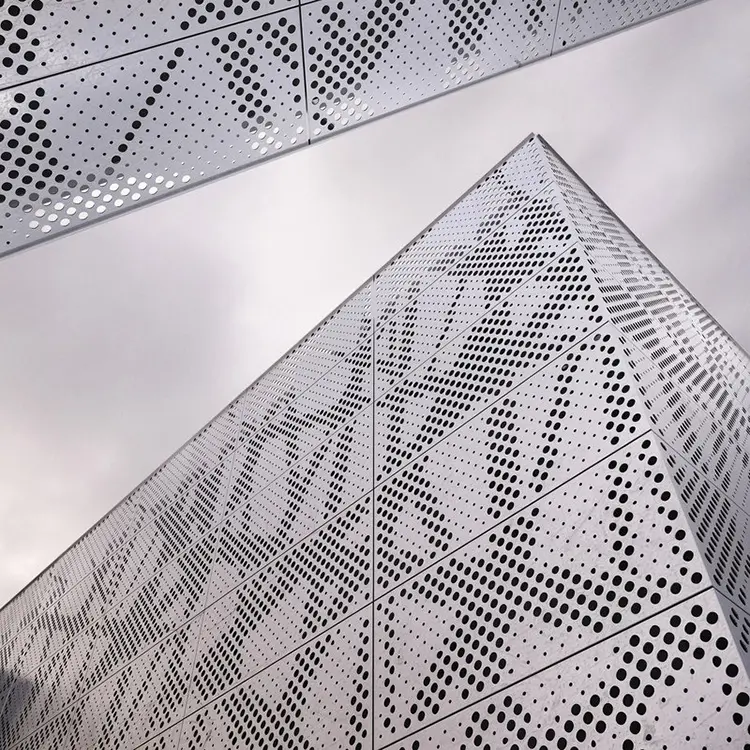
For a complex elevation, approve a multi-panel mock-up rather than one isolated panel. Include at least one real joint and one difficult transition. Photograph the accepted arrangement and keep the approved drawing revision with the production order.
Decide the process order before choosing the finish
Cutting, punching, deburring, bending, welding and coating affect one another. Openings are often made before the architectural finish so that cut edges can be prepared and coated, but the correct sequence depends on the specified finish and production route.
Ask the supplier to show the sequence on the sample submittal. Confirm which surfaces receive coating, how hanging or contact points are handled, and whether narrow bridges remain stable through finishing. If a prefinished sheet is proposed, require a sample that shows the real cut edge and face protection after processing. Do not approve a color chip as proof of the finished perforated panel.
For acoustic, airflow, privacy or shading goals, keep the claims separate. Opening area and geometry influence these functions, but a photograph or hole percentage does not establish the performance of the complete wall or ceiling assembly. Ask for the calculation or test evidence required by the project.
Turn factory capability into evidence you can approve
Likton supplies custom perforated aluminum panels and laser-cut decorative aluminum panels. The useful part for a buyer is not the product label. It is the ability to move from artwork to a controlled panel package: drawing review, a representative sample, forming details, finish approval, panel identification and protected packing.
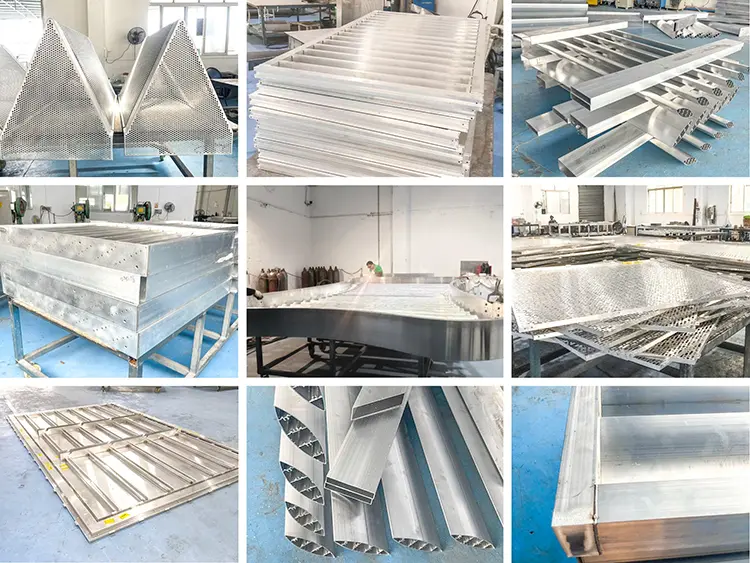
When asking Likton or another supplier for a sample, make it answer the difficult questions. Include the smallest opening, narrowest bridge, visible edge, folded return, proposed coating and one representative joint. Approve it with a drawing revision, not a photo sent without dimensions.
Before shipment, request panel-ID and packing photos for the batch. Complex patterns should be packed and labeled in an installation sequence that matches the elevation. This is where production control becomes a site benefit rather than a general factory claim.
Questions buyers ask before ordering
Can a perforated aluminum panel be laser cut?
Yes. “Perforated” describes the openings, not one mandatory manufacturing process. Repeated standard holes are often punched; irregular artwork may be laser cut. Ask the fabricator to identify the proposed method and sample requirements.
Is punching always cheaper than laser cutting?
No. Punching can be efficient for repeated holes, while laser cutting avoids dedicated shape tooling and handles variable contours. The result depends on setup, hit or cut count, panel repetition, material, secondary work and the equipment available. Compare complete quotations for the same drawing.
Which process gives a cleaner edge?
Neither wins automatically. Punching can leave fracture, burr or nibbling marks. Laser cutting can leave dross, burr or heat effects. Define the visible face, touchable edge and deburring requirement, then approve a sample made in the proposed material.
Can the artwork continue across many facade panels?
Yes, but the supplier needs a master elevation with real joints, panel IDs, orientation, edge margins and keep-out zones. Approve several adjacent panels together so alignment can be checked before mass production.
Should the openings be made before or after coating?
They are often made before the final architectural coating, but do not turn that into a universal rule. Confirm the full cutting, forming, preparation and finishing sequence with the supplier. If prefinished material is proposed, inspect the real processed edge and face protection.
Does a higher open area guarantee better acoustic or ventilation performance?
No. It can allow more free passage through the panel, but actual airflow, pressure drop, acoustic absorption and structural behavior depend on the complete assembly. Use project calculations or tested configurations where performance matters.
Send an RFQ that produces comparable quotations
| Include in the RFQ | Why it matters |
|---|---|
| CAD artwork plus a dimensioned PDF | Gives the supplier usable geometry and a human-readable reference |
| Panel elevation, IDs, orientation and joint widths | Controls a pattern that crosses multiple panels |
| Alloy, temper, thickness and panel size range | Affects cutting, forming, flatness and engineering review |
| Opening shape, size, spacing and edge margins | Defines the pattern instead of relying on a photograph |
| Quantity of each unique panel and likely repeat quantity | Allows a fair punching-versus-laser cost comparison |
| Folds, returns, stiffeners, fixings and keep-out zones | Prevents openings from conflicting with fabrication or installation |
| Visible face, burr rule and exposed-edge treatment | Turns “clean edge” into an inspectable requirement |
| Finish type, color reference and exposure | Connects edge preparation and process sequence to the final appearance |
| Sample or mock-up scope and approval owner | Prevents mass production from starting on an informal image approval |
| Panel numbering, inspection and packing method | Protects cross-panel patterns during delivery and installation |
To compare a real design, send Likton the CAD pattern, panel elevation and quantity split. Ask for the proposed fabrication route and any drawing changes to be stated before sampling. Choose after the representative sample meets the agreed edge, flatness and pattern checks, not from the process name alone.